

Want to onboard cross-functional teams quickly and effectively? Start with the right tools. Cross-functional teams often face challenges like communication gaps, conflicting goals, and unclear workflows. But with the right onboarding platforms, you can simplify processes, align teams, and boost productivity by over 70%.
Here’s what you need to know:
- Key Features to Look For: Collaboration tools, automation, system integration, analytics, and user-friendly interfaces.
- Top Tools:
- CTOx: Tailored for onboarding senior tech leaders ($3,000–$7,000/month).
- Enboarder: Personalized onboarding journeys with automation and multi-language support.
- Rippling: All-in-one HR solution for seamless workflows and app integrations.
- Rocketlane: Ideal for SaaS teams with project management and collaboration features.
- Userpilot: Focuses on in-app onboarding with customizable flows and analytics.
Quick Comparison:
| Tool | Best For | Key Strengths | Pricing (USD) |
|---|---|---|---|
| CTOx | Senior tech leadership | Strategic alignment, executive onboarding | $3,000–$7,000/month |
| Enboarder | Dynamic onboarding | Automation, personalization, multi-language | Custom pricing |
| Rippling | HR workflows | All-in-one platform, 400+ app integrations | Custom pricing |
| Rocketlane | SaaS team onboarding | AI playbooks, project management | Custom pricing |
| Userpilot | In-app user onboarding | Customizable flows, real-time analytics | Custom pricing |
Why It Matters: Effective onboarding improves retention by 82% and helps teams work 50% more efficiently. By combining the right tools with best practices – like setting clear goals, using digital workspaces, and automating tasks – you can ensure your cross-functional teams thrive from day one.
5 Best Onboarding Software Tools For Employees & Customers in 2022
What to Look for in Onboarding Tools
Choosing the right onboarding tool for cross-functional teams is a big deal. The right tool can speed up how quickly new hires get comfortable and productive while helping them connect with colleagues across different departments. Here’s what to keep in mind when evaluating your options.
Collaboration and Communication Features
A solid onboarding platform should act as a central hub for all team communication, cutting through the chaos of scattered conversations. Take Twilio, for example – they streamlined their communication by integrating Slack, project management tools, and shared documents. Sidharth Ramsinghaney, Director of Strategy and Operations at Twilio, highlighted the importance of this approach:
"One of the most impactful strategies I’ve employed in cross-team collaboration is the creation of a centralized communication hub." [2]
Look for tools that offer real-time feedback options and strong shared documentation features. These capabilities make it easier for team members to share updates, provide input, and stay in the loop on key projects.
Customization and Automation Options
Automation can be a game-changer for onboarding. It boosts efficiency and makes collaboration smoother.
The best tools allow you to use dynamic templates and create role-specific onboarding experiences. This means you can tailor workflows for different departments while maintaining consistency across the board. For instance, Vonage leveraged automation to consolidate customer data, dramatically cutting down provisioning time.
Customization is also key. Your tool should let you align the onboarding process with your company’s branding and adapt to the unique needs of various roles. This ensures new hires get the information that matters most to them.
Integration with Current Systems
Your onboarding platform should work seamlessly with the tools you already use – HR systems, project management platforms, CRM software, and communication tools. Strong integration capabilities can simplify processes like document management, contract generation, and payroll setup.
For example, organizations often integrate project management tools with CRMs like HubSpot, Salesforce, or Dynamics 365 to keep sales and project teams on the same page. Similarly, Borderless AI connects with existing HR systems to centralize onboarding activities, making tasks like compliance management and document automation much easier.
Make sure your tool supports platforms like Slack, Microsoft Teams, or Google Workspace so you can set up dedicated channels for new hire questions. Integration with project management software is also crucial for organizing deadlines, files, and notes across teams [13, 14]. These features not only streamline operations but also set the stage for better analytics and feedback.
Analytics and Reporting
Analytics are essential for understanding how well your onboarding process is working. A good tool should offer detailed tracking on new hire progress, engagement, and task completion rates. These insights can help you spot bottlenecks, identify areas where departments might need extra support, and measure how quickly new employees reach full productivity. Tools that provide both individual and team-level data empower managers to address personal growth needs and broader trends.
User Experience and Accessibility
An easy-to-use interface is critical for both new hires and managers. A clear, intuitive design minimizes the learning curve, which is especially important for team members with varying levels of tech-savviness. If your team includes remote or field-based employees, mobile accessibility is a must. The ability to access onboarding materials from any device ensures everyone can fully participate, no matter where they are. Consistent functionality across desktop and mobile platforms is key to keeping the process smooth and inclusive.
Best Tools for Cross-Functional Team Onboarding
Now that you’re familiar with what to look for, let’s explore some tools that can elevate your cross-functional team onboarding process. Each tool brings its own strengths to the table, whether it’s focusing on tech leadership or simplifying HR workflows, ensuring a smoother onboarding experience.
CTOx

CTOx is designed for onboarding senior tech leaders by bridging the gap between technology and business operations. It’s particularly useful for companies looking to integrate new tech executives into cross-functional teams. The platform offers tailored strategic guidance, helping tech leaders align quickly with business goals and contribute to critical operations.
CTOx provides three service models:
- Engaged: $7,000/month for weekly sessions.
- Half-Day Consult: $5,000/month for four-hour sessions.
- Advisor: $3,000/month for ongoing advisory support.
By focusing on the intersection of technology and business, CTOx ensures that new leaders hit the ground running.
Enboarder

Enboarder stands out for its ability to create dynamic, personalized onboarding journeys. Its Intelligent Journey Platform uses visual workflows and role-based assignments, making it a great fit for organizations with diverse team structures.
The platform’s automation capabilities have delivered impressive results for companies:
- Zapier: Saved 86 work weeks of repetitive tasks and boosted manager engagement by 10%.
- Foxtel Group: Achieved a 50% increase in eNPS scores within a year.
- Dermalogica: Recorded a 34% improvement in positive engagement.
With features like task automation, multi-language support, and a 4.95/5 rating on Research.com, Enboarder simplifies onboarding for cross-functional teams.
Rippling

For organizations seeking an all-in-one solution, Rippling integrates seamlessly with over 400 apps, including Google Workspace, Slack, and Zoom. It handles everything from paperwork to benefits enrollment in a single interface, making it ideal for larger companies managing complex onboarding workflows across departments like HR, IT, and finance.
Rocketlane

Rocketlane is tailor-made for SaaS teams, blending project management, document collaboration, and communication tools into one platform. With a 4.8/5 rating on G2, it’s a reliable choice for managing intricate onboarding processes.
Shehzad Karkhanawala, Vice President of Global Marketing at Joveo, shared:
"Rocketlane gives us a single source of truth for all things onboarding. We now have a way to benchmark, analyze, and optimize our onboarding process – with each new customer and for every project."
Additionally, Rocketlane’s branded onboarding portals and AI-powered playbooks ensure consistency across scenarios. Robert Block, Group Vice President of Professional Services & Customer Support at Clari, noted:
"Rocketlane helps us deliver more for less, taking us from just task management to strategic delivery with greater visibility and collaboration on project activities, ultimately driving up CSAT."
The platform’s shared workspaces and real-time feedback features further enhance collaboration, making it a strong option for cross-functional teams.
Userpilot
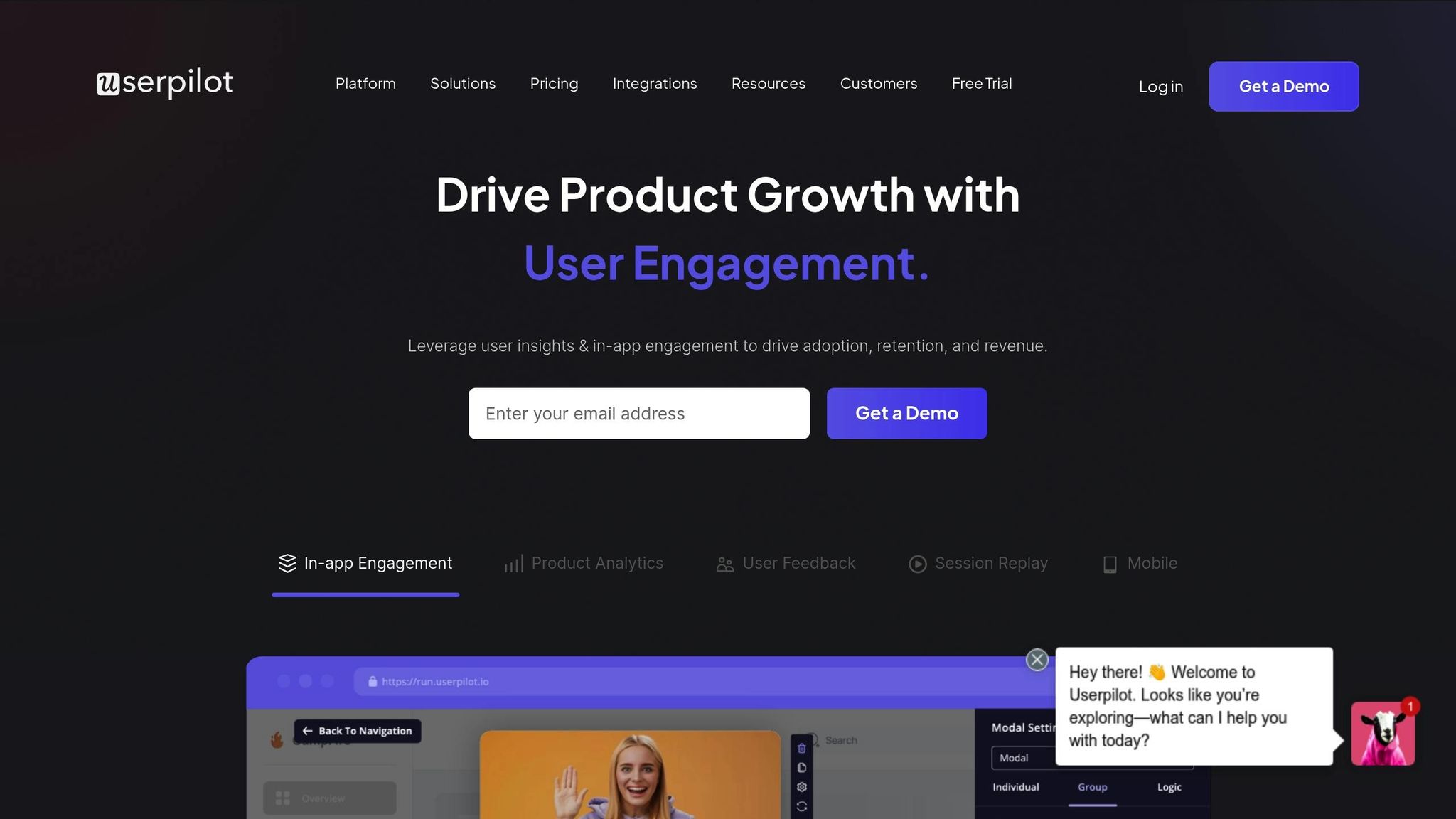
Userpilot is perfect for SaaS platforms aiming to deliver smooth in-app onboarding. It offers customizable flows, checklists, and in-app guidance, along with built-in analytics to track user interactions.
3P Learning saw significant improvements after switching to Userpilot. Tom Ulman, Lead Product Designer at 3P Learning, explained:
"The most powerful thing has been enabling marketers to be able to set up flows without dev assistance because we’ve got this growing bank of data that allows us to segment and change different rules."
Userpilot’s A/B testing and continuous optimization capabilities make it easy to refine onboarding processes. As Ulman added:
"Userpilot has allowed us to have this workspace where we can keep iterating in the platform. Again, minimal dev assistance, and keep making fine-tune touches. So it’s kind of like a constant A/B test where we can change things."
With its focus on real user feedback and iterative improvements, Userpilot is an excellent choice for teams looking to perfect their onboarding workflows.
sbb-itb-4abdf47
Tool Comparison
Choosing the right onboarding tool boils down to understanding your specific needs, budget, and existing tech stack. Each platform brings something different to the table, catering to various scenarios.
Comparison Table
| Tool | Best For | Key Strengths | Integration Options | Pricing (USD) | Analytics & Reporting |
|---|---|---|---|---|---|
| CTOx | Tech leadership onboarding | Strategic tech-business alignment and executive guidance | Custom integrations with enterprise systems | $3,000–$7,000/month | Executive-level KPI reporting and milestone tracking |
| Enboarder | Dynamic personalized journeys | Automation and personalization with visual workflow builders and multi-language support | 400+ app integrations including Slack and Zoom | Custom pricing | Advanced engagement analytics and eNPS tracking |
| Rippling | All-in-one HR workflows | Seamless app integration and paperwork automation | 400+ apps including Google Workspace and Slack | Custom pricing | Comprehensive HR analytics dashboard |
| Rocketlane | SaaS team onboarding | Integrated project management and communication tools with AI-powered playbooks | API integrations and CRM connectivity | Custom pricing | Real-time project analytics and CSAT tracking |
| Userpilot | In-app user onboarding | Customizable flows and iterative process refinement | SDK integrations and analytics platforms | Custom pricing | User interaction analytics and conversion tracking |
The table highlights the distinct features of each tool, but let’s dive into what makes each one stand out.
CTOx is perfect for companies onboarding senior technology executives. It bridges the gap between tech leadership and broader business goals, offering tailored solutions like the Advisor plan starting at $3,000 per month. This makes it a great choice for organizations seeking strategic, high-level guidance.
Enboarder shines with its visual workflow builder, enabling automation and personalization. Its multi-language support and compatibility with over 400 apps, including Slack and Zoom, make it a flexible option for dynamic, global teams.
Rippling is designed for organizations needing an all-in-one HR solution. It simplifies everything from IT setup to benefits management, integrating with over 400 apps. This makes it especially useful for larger companies managing complex, multi-department onboarding processes.
Rocketlane caters to SaaS teams, offering tools like AI-powered playbooks and integrated project management. Its focus on communication and collaboration ensures smoother onboarding for teams working on client-facing projects.
Userpilot excels at creating customizable in-app onboarding flows. It allows teams to refine processes continuously, with SDK integrations and robust analytics to monitor user interactions and drive conversions.
When selecting an onboarding tool, ensure it works seamlessly with your email, calendar apps, and ERP systems. Align the tool with your team’s collaboration habits to streamline the onboarding experience and maximize its impact.
Best Practices for Cross-Functional Team Onboarding
Getting onboarding right can make all the difference. Studies show that 31% of employees leave their jobs within the first six months, but companies with structured onboarding programs see an 82% increase in new hire retention. Beyond choosing the right tools, applying specific strategies can significantly improve cross-functional onboarding.
Set Clear Goals
A successful onboarding program begins with clear objectives that tie individual roles to broader company goals. Without a solid direction, teams risk confusion and delays.
For example, set role-specific milestones that connect directly to business outcomes. Developers and marketers, for instance, will have very different goals. Use tools like a project charter to outline the work ahead, define roles, and establish targets.
"A detailed project plan should clearly define roles and responsibilities, set achievable deadlines, and include a strategy for managing risks. This helps everyone know what they need to do and when, making it easier to stay on track and avoid issues. A solid plan keeps everyone accountable and engaged, making the collaboration much smoother."
- Laia Quintana, Head of Marketing and Sales at TeamUp [2]
Make goals measurable and time-sensitive. Instead of setting vague objectives like "learn the system", aim for something specific, such as "complete three client onboarding scenarios within the first two weeks."
Use Digital Workspaces
Digital workspaces act as the central hub for cross-functional onboarding, providing around-the-clock access to resources and fostering transparency across teams.
Create a straightforward, one-page document that lists all the platforms employees will use, their purposes, and any relevant guidelines. This simple step can reduce confusion, which affects 72% of new hires.
Automated workflows on platforms like Slack or Microsoft Teams can further streamline processes. For example, automatically granting access to tools and resources can simplify the first few days.
"The new hire experience is a critical journey within the broader employee journey – one that sets the path of success for employees. Organizations must take stock of the important moments in the onboarding journey, finding ways to measure and improve them. It’s no longer just about ticking the boxes on an onboarding checklist."
- Cecelia Herbert, Principal Behavioral Scientist at Qualtrics
Companies like CrowdStrike exemplify this approach. By 2025, they implemented a "white glove" onboarding experience that includes learning about the company’s mission and values on day one, followed by virtual workshops at 30, 60, and 90 days.
Digital workspaces also offer better security than traditional paper processes, with features like end-to-end encryption and secure document storage – vital for handling sensitive cross-functional data.
Assign Onboarding Buddies or Mentors
Pairing new hires with experienced team members helps build human connections, which are crucial in cross-functional teams where employees need to understand multiple departments and workflows.
Select mentors who not only excel in their roles but also understand how their work impacts other departments. For instance, a marketing mentor should grasp how campaigns influence sales, and a development mentor should know how their code affects customer support.
Structure these relationships with clear expectations. Mentors should:
- Schedule regular check-ins during the first 90 days.
- Introduce new hires to key contacts across departments.
- Guide them through cross-functional projects.
Mentorship works best when it’s a two-way street. New hires can bring fresh insights, offering value to mentors while also helping refine existing processes.
Automate Repetitive Tasks
Onboarding often involves repetitive administrative tasks that can overwhelm both new hires and managers. Automation can free up time for more meaningful interactions.
Use templates for tasks like account setup, equipment requests, or training schedules. Onboarding platforms can automatically assign tasks based on role, department, and start date, and send reminders for key milestones.
Gather essential information – like paperwork and emergency contacts – before day one through digital forms. This allows more time for strategic discussions and relationship-building once the new hire starts.
Collect Feedback and Improve
What sets great onboarding programs apart is their commitment to continuous improvement. Regular feedback ensures you’re addressing what works and fixing what doesn’t.
Gather input during key stages like pre-arrival, orientation, and integration. Use pulse surveys at milestones (day 1, week 1, month 1) and digital suggestion boxes for ongoing feedback.
Anonymity is key to getting honest responses. Anonymous surveys help employees share their thoughts without fear, providing candid insights into their experience.
One healthcare organization improved employee retention by 25% by reviewing new hire feedback with HR and department managers to identify and address challenges.
Develop an action plan to tackle immediate pain points and communicate the changes to employees. This builds trust and shows a commitment to improving the experience.
| Feedback Method | Best Use Case | Key Benefits |
|---|---|---|
| Anonymous Surveys | Honest opinions on sensitive topics | Encourages candid responses, easy to analyze |
| One-on-One Meetings | In-depth discussions on challenges | Builds personal connections and provides detailed insights |
| Digital Feedback Platforms | Real-time input collection | Convenient, trackable, and immediate |
With 81% of new employees feeling overwhelmed by onboarding, a strong feedback system can help identify and resolve issues before they lead to early turnover.
Conclusion
Selecting the right onboarding tools can significantly impact cross-functional team success. Structured onboarding programs have been shown to improve retention rates by 82% and increase productivity by over 70%. These results underscore the importance of the strategies and tools we’ve outlined for effective cross-functional onboarding.
Let’s recap how the key platforms discussed align with these needs. Each tool brings its own strengths to the table: CTOx emphasizes strategic tech leadership, Enboarder focuses on creating personalized onboarding experiences, Rippling streamlines HR operations, Rocketlane supports collaborative project management, and Userpilot enhances in-app training experiences.
While efficient onboarding tools can reduce administrative burdens, they’re only part of the equation. The real magic happens when tools are paired with best practices like setting clear objectives, utilizing digital workspaces, automating repetitive tasks, and gathering continuous feedback. These steps turn functional tools into catalysts for exceptional outcomes.
The right onboarding tools not only accelerate time-to-productivity but also strengthen team cohesion and improve retention. When choosing a solution, consider your team’s specific needs – whether that’s collaborative workspaces, seamless administrative automation, or advanced tech leadership. Integration capabilities with your current systems and user-friendly interfaces are also critical for smooth adoption. A unified onboarding strategy doesn’t just streamline processes; it empowers teams to thrive in today’s competitive environment. By mastering onboarding, cross-functional teams can gain a significant edge in attracting and retaining top talent, ensuring long-term success and continuous growth.
FAQs
What’s the best way to choose an onboarding tool for my cross-functional team?
To choose the best onboarding tool for your cross-functional team, begin by evaluating key aspects like your team’s size, how they collaborate, and the complexity of your projects. Prioritize tools that provide an easy-to-use interface, adapt to your team’s growth, integrate effortlessly with your current systems, and come with dependable support.
Take a moment to reflect on previous onboarding experiences. Pinpoint any challenges or gaps, and make sure the tool’s features align with your team’s specific goals. By keeping these factors in mind, you can set up an onboarding process that’s streamlined, effective, and tailored to what your team truly needs.
What are the benefits of integrating onboarding tools with systems like CRM and project management software?
Integrating onboarding tools with systems like CRM and project management software can make a huge difference for your team. It brings everything together in one place, making cross-department collaboration much easier. With centralized access to customer details and project updates, everyone stays on the same page and works toward shared goals more effectively.
It also helps smooth out workflows by cutting down on data duplication and making task transitions more seamless. Plus, with real-time communication and feedback built in, teams can make better decisions and keep projects on track. These improvements don’t just save time – they also boost productivity, keep customers happier, and strengthen the overall performance of your organization.
How can automated onboarding tools boost efficiency and productivity for cross-functional teams?
Automated onboarding tools streamline the onboarding process, making it faster and more efficient. By cutting down on manual tasks and reducing errors, these tools ensure a smoother experience for new hires, helping them get up to speed and start contributing sooner.
They also improve teamwork across departments by centralizing key information and automating workflows. This removes common bottlenecks, freeing up teams to focus on more strategic priorities instead of getting bogged down by administrative work. The result? A more productive and cohesive workplace.